
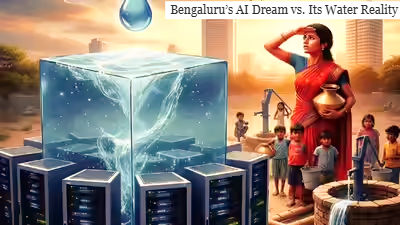
💧 Bengaluru’s AI Dream vs. Its Water Reality

Can India’s Tech Capital Scale Artificial Intelligence Without Running Dry? 🤖🌆
Bengaluru wants to be India’s AI capital. 🚀
The city already leads the country in startups, software exports, and global capability centres. It hosts tech giants, unicorn founders, and some of the brightest AI minds in Asia. But behind the glow of server racks and venture capital headlines lies an uncomfortable truth:
Artificial Intelligence may be digital — but its infrastructure is deeply physical.And that physical infrastructure runs on something Bengaluru is already struggling with — water. 💧

🏗️ The Data Centre Boom: Fueling the AI Revolution
Artificial Intelligence runs on compute power — massive clusters of servers processing vast datasets around the clock.
And those servers live inside data centres.
Here’s the reality:
31 of Karnataka’s 32 data centres are located in Bengaluru.
More hyperscale campuses are planned.
More megawatts are being added.
More cooling systems are being installed.
On paper, this sounds like growth.In reality, it’s a resource equation.
💦 The Water Math No One Talks About
Let’s break this down clearly.
A 1 MW data centre requires approximately 68,500 litres of water per day.
A 20 MW AI facility needs roughly 1.4 million litres daily.
That’s equivalent to the daily water consumption of 27,000 urban homes.
Now pause for a moment. ⏸️
Imagine a single AI campus using as much water as an entire mid-sized town — every single day.
And that’s just one facility.
As AI models grow larger and more compute-intensive, hyperscale data centres grow with them.
🧊 Why Do Data Centres Need So Much Water?
Servers generate enormous heat while processing data.
If not cooled efficiently, they:
Slow down
Malfunction
Or completely fail
Cooling systems typically use:
Evaporative cooling
Cooling towers
Chilled water systems
Water absorbs heat and evaporates, helping regulate temperature.
So while AI might seem like cloud magic ☁️Its foundation is steel, concrete, electricity — and water.
🚰 Meanwhile, Bengaluru Is Already Thirsty
Now here’s the bigger issue.
Bengaluru already faces:
Severe water shortages
Declining groundwater levels
Dry borewells
Rising tanker dependency
Escalating water costs
Residents are literally counting every drop. 💧
Entire neighbourhoods rely on private water tankers.Apartment associations ration supply.Summer months intensify the crisis.
And into this fragile ecosystem enters large-scale AI infrastructure demanding millions of litres daily.
The tension is undeniable.
⚡ AI Runs on Compute. Compute Runs on Power. Power Often Runs on Water.
Here’s the deeper systems view:
1️⃣ AI needs massive compute.
2️⃣ Compute requires electricity.
3️⃣ Thermal power generation uses water.
4️⃣ Data centre cooling uses water again.
It’s a layered dependency chain.
So the water footprint isn’t just direct cooling usage — it includes upstream energy generation too.
This multiplies the sustainability question.
🌬️ Are There Solutions?
Yes — and some companies are already exploring alternatives.
✅ Air-Cooled Systems
Instead of water-based cooling, some facilities are using advanced air circulation systems.
✅ Liquid Immersion Cooling
Servers submerged in special dielectric fluids reduce evaporation-based water usage.
✅ Zero-Water Cooling Designs
Newer facilities are designed to operate without freshwater dependency.
✅ Renewable Energy Integration
Reducing water-intensive thermal power reliance.
These innovations are promising. But here’s the catch:
Adoption must outpace expansion.
If hyperscale campuses grow faster than sustainable cooling solutions, the net water burden still rises.
📈 Growth vs. Sustainability: The Real Question
The debate isn’t about stopping AI growth.
AI brings:
Economic expansion 💰
Job creation 👩💻
Innovation breakthroughs 🧠
Global competitiveness 🌍
The real question is:
Can Bengaluru scale responsibly?
Because the future isn’t just about being India’s AI capital.It’s about being a sustainable AI capital.
🏙️ Urban Planning Meets Digital Ambition
This moment demands coordination between:
Urban planners
State policymakers
Infrastructure developers
Tech companies
Environmental regulators
Strategic decisions could include:
Water-neutral data centre mandates
Mandatory recycling & greywater reuse
Incentives for zero-water cooling
Zoning policies that distribute infrastructure regionally
Encouraging data centre diversification beyond Bengaluru
Because concentration increases pressure.
🔍 The Broader Global Context
This isn’t just a Bengaluru story.
Globally, AI expansion has sparked similar concerns in:
The U.S. Southwest
Parts of Europe
Singapore
Wherever water stress exists, hyperscale data centres force hard trade-offs.
The difference? Bengaluru’s water stress is already visible and immediate.
💡 A Defining Crossroads
Bengaluru stands at a historic moment.
On one side:
AI dominance
Massive capital inflows
Global recognition
On the other:
Water scarcity
Urban strain
Environmental fragility
If done right, Bengaluru could become a global model for sustainable AI infrastructure.
If done carelessly, it risks deepening an already fragile water crisis.
🌍 Intelligence Must Include Sustainability
Artificial Intelligence is about optimization,Efficiency ,Smart decision-making.
Perhaps the most intelligent move now is ensuring that the growth of AI does not outpace the sustainability of its ecosystem.
Because true innovation isn’t just about faster models.
It’s about building a future where technology and resources coexist.
Bengaluru doesn’t just need to be the AI capital of India.
It needs to be the responsible AI capital of India. 💧🤖


Comments