
Char Dham: A Divine Journey Through India’s Four Sacred Abodes 🌸🙏✨
- telishital14

- Mar 18, 2025
- 5 min read
India, a land of deep spirituality and profound culture, is home to numerous pilgrimage sites that attract millions of devotees every year. Among them, the Char Dham holds a revered place in the hearts of Hindus. These four sacred pilgrimage sites—Badrinath, Dwarka, Puri, and Rameswaram—are believed to guide one’s spiritual journey, culminating in the ultimate goal of moksha (liberation). Each of these temples is dedicated to a divine form of Lord Vishnu or Lord Shiva, representing the key epochs of Hindu mythology.
Let’s embark on a spiritual journey to understand the significance of the Char Dham, and explore the temples that have been worshipped for centuries. 🌸
What is Char Dham? 🌏💫
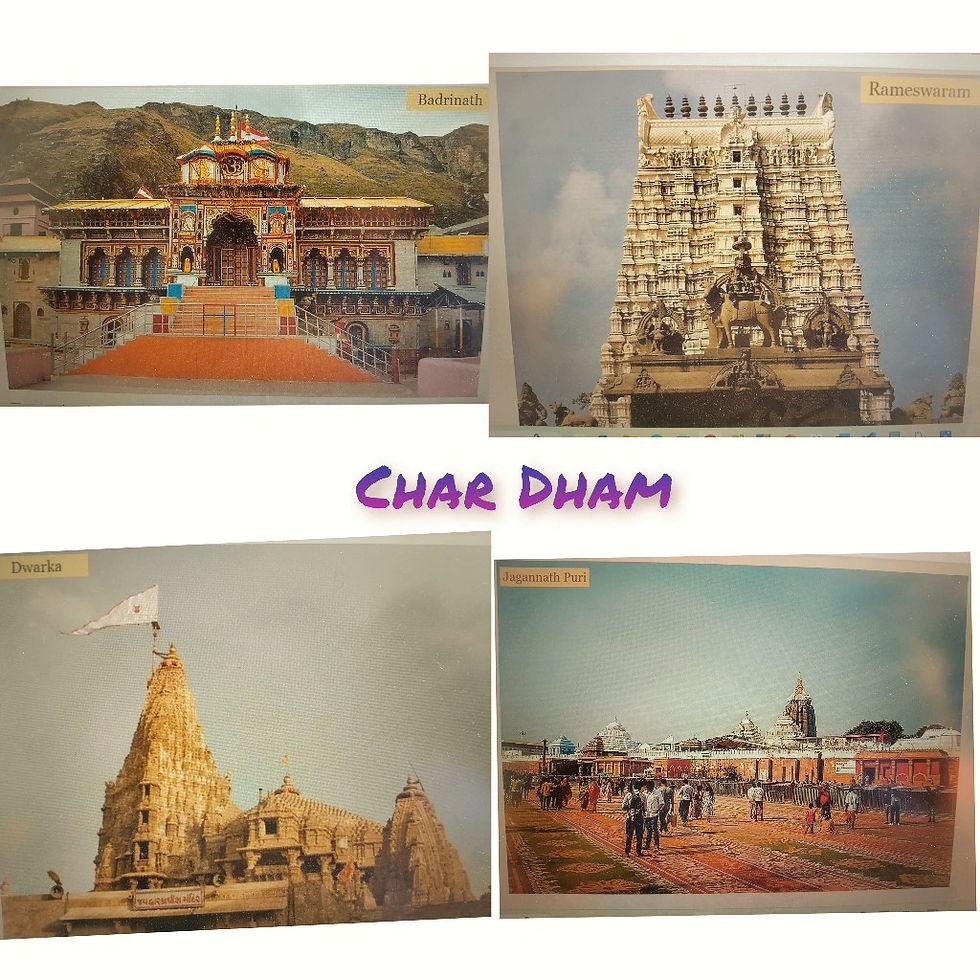
The Char Dham (Hindi: चारधाम, "the four abodes") or Chatur Dhama (Sanskrit: चतुर्धाम) are four sacred pilgrimage sites located across India, each representing a unique yuga (epoch) in Hindu tradition. These sites are:
Badrinath (Satya Yuga) - The abode of Lord Vishnu
Rameswaram (Treta Yuga) - The abode of Lord Shiva
Dwarka (Dvapara Yuga) - The abode of Lord Krishna
Puri (Kali Yuga) - The abode of Lord Vishnu in his form of Jagannath
These four dhams were defined by the great Hindu philosopher, Adi Shankaracharya, to represent different periods in Hindu cosmology. 🌟 The Char Dham journey is said to cleanse one’s soul and help in the quest for moksha. 🌿
Badrinath - The Abode of Lord Vishnu 🏔️🌺
Nestled in the Himalayas at an altitude of 3,133 meters, Badrinath in Uttarakhand is a spiritual hotspot dedicated to Lord Vishnu. The legend of this holy site dates back to Nara-Narayana, divine twin brothers who meditated here to attain spiritual enlightenment. 🌲

The temple is located on the banks of the Alaknanda River, surrounded by breathtaking mountains like Nilkantha Peak. The site is named after Badari (the berry tree) as it is believed that Goddess Lakshmi transformed into a berry tree to protect Narayana during his penance. 🙏
The temple is open for pilgrims from April to October every year, with Joshimath serving as the winter seat. Nearby attractions like Mana, Vyas Gufa, and Bhimkund make it an enriching destination for those seeking both spirituality and adventure. 🌄
Rameswaram - Where Rama Worshipped Lord Shiva ⛩️🔥
Located in the southern tip of India, Rameswaram in Tamil Nadu holds a significant place in Hindu mythology. This temple town is most famous for the Ramanathaswamy Temple, dedicated to Lord Shiva. 🕉️ The legend goes that Lord Rama worshipped Shiva here to atone for the sin of slaying Ravana, a devotee of Lord Shiva.

It is believed that Rama installed a lingam here, which became the center of worship, and the Ramanathaswamy Temple is one of the 12 Jyotirlingas of India. 🏝️ The temple also houses the Rama Setu (Adam's Bridge), the mythical bridge built by Rama and his allies to reach Lanka and rescue his wife Sita.
A pilgrimage to Rameswaram is considered incomplete without visiting Varanasi. It’s a must-visit destination for spiritual seekers and devotees of Lord Shiva. 🌊
Dwarka - The Legendary City of Lord Krishna 🌊💖
In the westernmost part of India, on the coast of Gujarat, lies the ancient city of Dwarka. According to legend, this is where Lord Krishna established his kingdom, making it one of the holiest places for Hindus. 🌅 The Dwarakadheesh Temple is dedicated to Lord Krishna and is one of the most prominent temples in India.

Dwarka is said to be the site of the original Dvārakā, a city that was submerged by the sea six times. The present city of Dwarka is believed to be the seventh iteration. 🏖️ The town is also home to the Dwarka Peeth (a monastic center established by Adi Shankaracharya), making it an important spiritual center for Hindus. 🛕✨
Puri - The Home of Lord Jagannath 🌾🕉️
Located on the eastern coast of India in the state of Odisha, Puri is one of the most ancient cities in India, and the Jagannath Temple here is a significant pilgrimage site. The main deity, Lord Jagannath, is considered a form of Lord Vishnu, and is worshipped along with his siblings, Balabhadra and Subhadra. 🌸
The Jagannath Rath Yatra is one of the most famous festivals in India, attracting millions of pilgrims each year. The Goverdhan Matha, founded by Adi Shankaracharya, is located in Puri, making it one of the cardinal centers of the Char Dham. 🏖️

The Spiritual Significance of the Char Dham Journey 🚶♂️💖
The Char Dham pilgrimage is not just about visiting sacred sites; it is a journey of self-discovery and spiritual growth. It is believed that by visiting these four divine abodes, one purifies their soul and moves closer to attaining moksha or liberation from the cycle of birth and death. 🌌
Each Dham holds a special connection to the various Yugas:
Badrinath represents the Satya Yuga, the age of truth.
Rameswaram represents the Treta Yuga, the age of sacrifice.
Dwarka represents the Dvapara Yuga, the age of duality.
Puri represents the Kali Yuga, the current age, where the divine presence of Lord Vishnu, as Jagannath, guides us.
This sacred journey is more than just a religious duty; it is an opportunity to reflect on one’s inner self and connect with the divine. 🌿✨
A Revered Legacy by Adi Shankaracharya 🙏🕉️
The Char Dham circuit was systematically organized by Adi Shankaracharya, the great philosopher and spiritual leader. He also established the Amnaya Maṭhas—four monasteries—at each of the Char Dham locations to preserve the teachings of Sanatana Dharma and offer a place of worship and spiritual learning.

Puri: Govardhan Matha - East
Rameswaram: Sringeri Sharada Peetham - South
Dwarka: Dvāraka Peetham - West
Badrinath: Jyotirmaṭha - North
These monasteries continue to serve as spiritual hubs for thousands of pilgrims and seekers. 🌸
Chota Char Dham & Winter Char Dham: Spiritual Journeys Beyond the Norm 🌄❄️
In addition to the grand Char Dham, there exists a smaller yet equally significant pilgrimage circuit known as Chota Char Dham. Located in the scenic state of Uttarakhand, this revered circuit includes four ancient pilgrimage sites: Yamunotri, Gangotri, Kedarnath, and Badrinath. 🌸 This sacred journey holds special significance, as the Pandavas themselves are believed to have taken this route to heaven. The temples of Chota Char Dham are open from the last week of April to the first week of May and close from the last week of October to the first week of November, with opening and closing dates announced by the head priest of Ukhimath Temple.

Additionally, Uttarakhand has introduced the Winter Char Dham initiative to extend the pilgrimage experience during the off-season. 🏔️ While the main Char Dham temples are closed during winter, the deities are relocated to nearby villages for worship. The Winter Char Dham includes sites like Omkareshwar Temple in Ukhimath for Kedarnath, Pandukeshwar in Chamoli for Badrinath, Mukhba in Uttarkashi for Gangotri, and Kharsali for Yamunotri. ❄️ These winter abodes offer pilgrims a unique chance to experience the divine in a different season, maintaining the sacred connection with the deities year-round. 🌟
Whether you’re exploring the Chota Char Dham or venturing into the winter circuits, these sacred sites offer an unparalleled spiritual journey, one that connects you to the heart of Hindu spirituality, irrespective of the time of year. 🙏🌿
Embark on a Sacred Pilgrimage 🚶♀️🌈
The Char Dham pilgrimage is not just a physical journey across the diverse landscapes of India, but a spiritual odyssey that connects devotees to the divine and brings them closer to their ultimate goal of liberation. Whether it’s the majestic Badrinath Temple, the serene Rameswaram, the mystical Dwarka, or the vibrant Puri, each of these sacred sites offers a profound experience. 🌟
So, pack your bags, embark on this sacred journey, and immerse yourself in the divinity of the Char Dham. Your soul will thank you for it! 🌼


This blog was really informative! I got to know about Char Dham through it. ✨️