
🚀 DRDO Successfully Qualifies Gaganyaan’s Drogue Parachute: A Giant Leap Towards India’s Human Spaceflight Dream 🇮🇳🪂

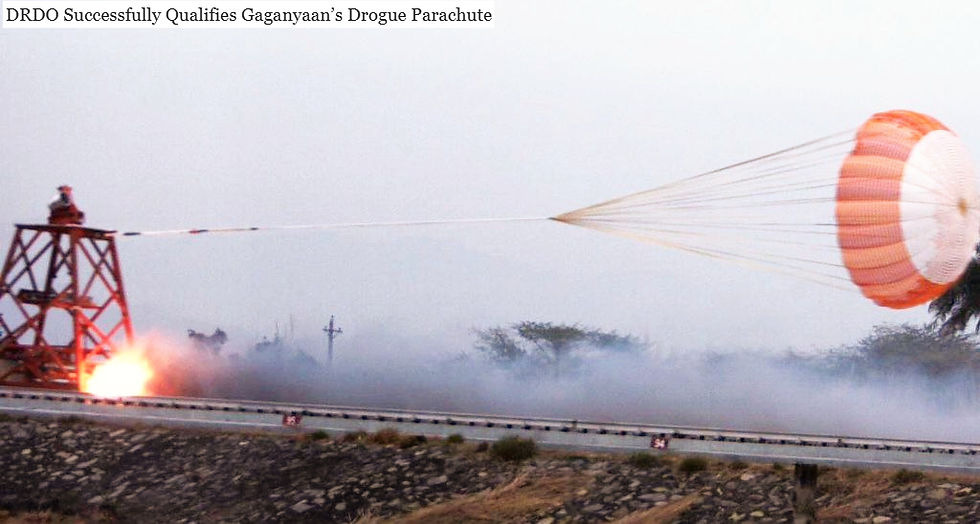
India’s ambitious human spaceflight programme, Gaganyaan, has reached another significant milestone! The Defence Research and Development Organisation (DRDO) has successfully conducted the qualification-level load test of the Gaganyaan mission’s drogue parachute at its advanced Rail Track Rocket Sled (RTRS) facility in Chandigarh.
This achievement is more than just a technical success — it is a powerful statement of India’s growing self-reliance in critical aerospace technologies under the vision of Atmanirbhar Bharat. 🇮🇳

🌌 Understanding the Gaganyaan Mission
India’s Gaganyaan programme, led by the Indian Space Research Organisation (ISRO), aims to send Indian astronauts (Vyomnauts 👨🚀👩🚀) into space and bring them safely back to Earth.
While launching astronauts into orbit is a complex feat, ensuring their safe return is equally — if not more — critical. The crew module re-entry and landing phase involves extreme heat, high velocities, and immense aerodynamic forces. This is where the parachute system plays a life-saving role.
🎯 What Is a Drogue Parachute and Why Is It Important?
During re-entry, the crew module descends at extremely high speeds. The drogue parachute is deployed in the initial phase of descent.
🔑 Key Functions of the Drogue Parachute:
✅ Stabilises the crew module during descent
✅ Reduces velocity significantly before main parachutes deploy
✅ Ensures controlled orientation
✅ Prepares the module for safe splashdown
Without a properly functioning drogue parachute, the module could become unstable or descend too fast — posing serious risks to astronauts.
In simple terms:👉 The drogue parachute is the first line of safety during Earth return.
🏗️ Where Was the Test Conducted?
The qualification-level test took place at the prestigious:
Terminal Ballistics Research Laboratory (TBRL), Chandigarh
Home to India’s advanced Rail Track Rocket Sled (RTRS) facility
The RTRS is recognised as one of India’s most advanced ground-based dynamic evaluation platforms.
🚀 What Makes RTRS Special?
Simulates high-speed aerodynamic conditions
Conducts ballistic and dynamic assessments
Used extensively for defence and aerospace testing
Capable of replicating extreme stress environments
The sled system accelerates test objects to very high speeds along a rail track to simulate real-world flight conditions. This allows engineers to test parachute systems under controlled yet extreme scenarios.
🔬 What Happened During the Qualification Test?
In this latest trial, engineers didn’t just test the parachute under normal conditions — they went beyond!
💥 Stress Beyond Operational Limits
The drogue parachute was subjected to loads exceeding the maximum levels expected during actual flight conditions.
Why? 🤔
Because qualification testing is about building confidence and safety margins. By pushing the parachute beyond its expected limits:
Engineers verify structural integrity
Validate design robustness
Ensure additional safety buffer
Reduce mission risk
This approach ensures that even if unexpected conditions arise during the mission, the system remains reliable.
🤝 Collaboration: DRDO, ISRO & ADRDE
This success is a result of powerful collaboration between:
DRDO
Vikram Sarabhai Space Centre (VSSC) under ISRO
Aerial Delivery Research and Development Establishment (ADRDE)
Such inter-agency coordination showcases India’s integrated defence and space ecosystem.
The collaboration highlights how defence research infrastructure is being effectively leveraged for civilian and space applications — a smart and strategic move.
🧵 High-Strength Ribbon Parachutes: A Technological Breakthrough
Officials noted that this success demonstrates India’s expanding capability in designing and manufacturing high-strength ribbon parachutes tailored for complex aerospace missions.
Ribbon parachutes are specially designed to:
Handle high-speed airflow
Withstand intense aerodynamic forces
Maintain stability during supersonic descent
Offer reliable deployment under extreme conditions
Developing these domestically is a major achievement.
This reduces dependence on foreign suppliers and strengthens India’s aerospace manufacturing ecosystem.
🏆 A Boost to Atmanirbhar Bharat
Defence Minister Rajnath Singh congratulated DRDO, ISRO, and industry partners, calling it a major stride toward strengthening India’s self-reliance in critical space technologies.
This aligns perfectly with the vision of:
🇮🇳 Atmanirbhar Bharat (Self-Reliant India)
By mastering complex systems like parachutes, India:
Builds strategic autonomy
Reduces import dependency
Enhances indigenous R&D capability
Strengthens national security
Boosts global confidence in Indian space technology
🌍 Why This Milestone Matters Globally
Human spaceflight is an elite club. Only a handful of nations have successfully sent humans to space and brought them back safely.
With milestones like this, India is steadily progressing toward joining that group with full technological confidence.
This isn’t just about sending astronauts to space — it’s about:
✨ Technological excellence
✨ National pride
✨ Scientific advancement
✨ Industrial growth
✨ Future deep-space ambitions

🔮 What’s Next for Gaganyaan?
With the drogue parachute qualification successfully completed:
Further integrated system testing will continue
Crew escape system validations will be strengthened
Full-scale mission readiness steps will accelerate
Each successful test brings India one step closer to witnessing its astronauts orbit Earth under the tricolour.
💬 Final Thoughts
The successful qualification-level load test of the Gaganyaan drogue parachute is not just a routine engineering milestone — it is a powerful symbol of India’s maturing aerospace capabilities.
From high-speed rocket sled testing in Chandigarh to astronaut safety during splashdown, every component plays a critical role in shaping India’s human spaceflight future.
And with institutions like DRDO and ISRO working hand in hand, the dream of seeing Indian astronauts in space is no longer distant — it’s becoming a reality.
India is not just reaching for the stars — it is building the technology to return safely from them.


Comments