🇫🇮 Finland: The Happiest Country in the World — What Does Finland Know About Happiness That We Don’t?❄️

Imagine waking up in a country where silence is comfortable, forests are everywhere, children walk to school independently, work does not consume your entire life, and a sauna is not a luxury but a part of everyday life.
Now imagine that this country experiences months of darkness, temperatures can fall to −30°C, the language is notoriously difficult for outsiders, and life is far from inexpensive.
Yet, year after year, Finland continues to be recognized as the world's happiest country.
So what is the secret?
Is it money?Is it nature?Is it education?Is it healthcare?Is it social trust?
Or is happiness in Finland something much deeper?
Finland—not simply as a tourist destination, but as a way of life.
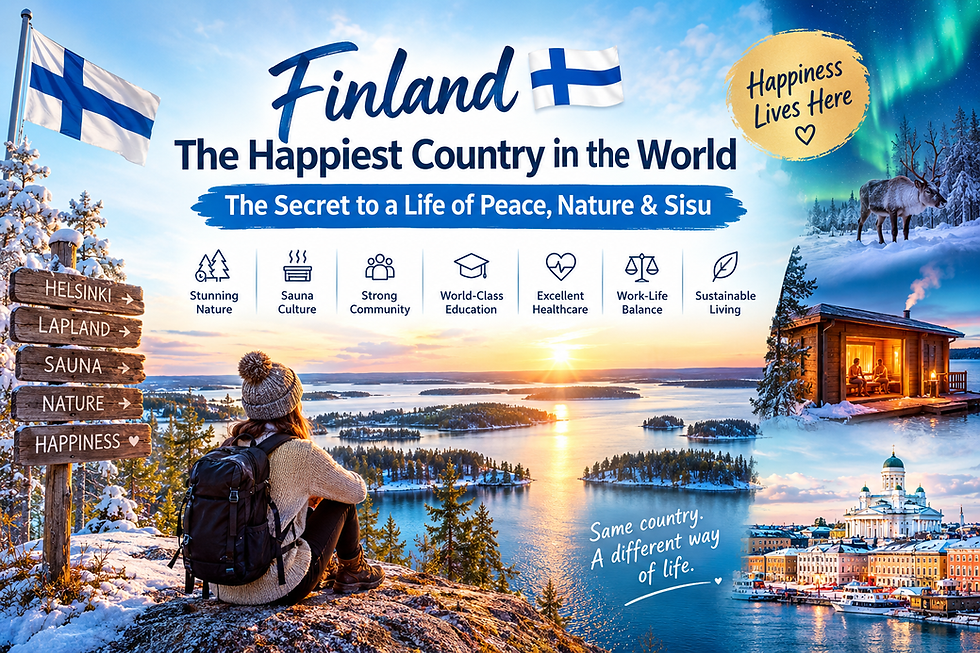
Finland: A Small Country With a Remarkable Way of Life
Located in the far northeast of Europe, Finland is home to around 5.5 million people.
It sits between forests, lakes, islands, and the Baltic Sea. Unlike the image many people have of Europe—with crowded cities, Mediterranean beaches, and dramatic mountain ranges—Finland offers something completely different.
Its landscape is shaped by ice.
Thousands of years ago, glaciers moved across the region, carving lakes, forests, islands, and rocky landscapes that still define Finland today.
And the numbers are extraordinary:
Finland by the numbers
💧 188,000 lakes
🌲 Forests cover around 75% of the country
🔥 Around 3 million saunas
☕ Finns consume roughly 12 kg of coffee per person annually
🌞 In northern Finland, the sun can remain above the horizon for weeks during summer
🌙 During winter, parts of the north experience extremely long periods without sunrise
These aren't merely geographical statistics.
They influence how Finns work, relax, socialize, raise families, and understand life.
The environment teaches patience.
The weather teaches preparation.
And the long periods of darkness teach people to appreciate light.
Nature Is Not a Weekend Activity—It Is Part of Life
One of the biggest differences between Finland and many modern societies is the relationship people have with nature.
In Finland, nature isn't something you necessarily need to "escape to" on vacation.
It is already around you.
Forests, lakes, islands and countryside are woven into everyday life.
In eastern Finland, Lake Saimaa stretches across thousands of square kilometers, creating a maze of islands and waterways.
Summer cottages sit beside lakes, sometimes far away from neighbors and modern conveniences.
For many Finns, this isn't isolation.
It is freedom.
It is perfectly normal to spend time in a quiet cottage surrounded by trees and water, with nothing but the sound of birds and the lake.
The Finnish philosophy of nature
The Finnish lifestyle suggests an important idea:
You don't always need more stimulation. Sometimes you need less.
In a world dominated by notifications, social media, traffic, emails and constant communication, Finland offers something increasingly rare:
silence.
And perhaps silence itself is one of the country's greatest luxuries.
When −30°C Is Just "Weather"
Finland's climate isn't easy.
In Lapland, temperatures can fall to −30°C, while snow can reach impressive depths.
Yet schools remain open.
Buses continue running.
Children still play outside.
People continue going to work.
For Finns, extreme cold isn't necessarily treated as an emergency.
It's simply part of life.
That requires a particular mindset:
Prepare instead of panic.
Finnish people adapt to their environment rather than constantly fighting against it.
They dress appropriately.
They plan ahead.
They carry emergency supplies.
They respect the weather.
This attitude reflects something deeply Finnish:
Sisu.
We'll return to that powerful word later.
The Finnish Morning: Coffee, Silence and No Rush
A typical Finnish morning might begin with something surprisingly simple:
Coffee.
Finns are among the world's biggest coffee consumers, drinking approximately 12 kilograms per person every year, according to the transcript.
But coffee isn't simply caffeine.
It's a ritual.
A moment to sit.
A moment to pause.
A moment to look outside.
And perhaps most importantly, a moment where nobody feels obligated to fill the silence.
Coffee + Silence + Time = A Finnish Morning
There is something fascinating about this.
In many cultures, silence can feel uncomfortable.
People immediately reach for their phones.
They start conversations.
They turn on television or music.
But in Finland, silence can simply be... silence.
And nobody needs to fix it.
A Society Built on Trust
One of the most striking examples of Finnish social trust is children travelling independently.
The transcript describes Finnish children, some as young as seven, walking to school alone.
Why?
Because Finland is considered one of the world's safest countries, and independence is encouraged from an early age.
This reflects a larger cultural principle:
Trust creates independence.
Instead of constantly controlling children, society gives them space to become responsible.
And that trust extends beyond children.
Finnish society generally operates on the assumption that people will follow rules, respect others and do their part.
That creates something incredibly valuable:
low everyday anxiety.
Work Is Important—But It Is Not Your Entire Identity
Perhaps one of the most important lessons from Finland is its relationship with work.
In cities such as Espoo, Finland has developed a strong technology ecosystem.
Companies such as Nokia originated here, while Finnish technology and gaming companies have achieved international recognition.
But the workplace culture described in the transcript is notably different from traditional corporate environments.
There are:
Flatter hierarchies
Short and direct meetings
Less emphasis on status
Practical communication
Less obsession with appearances
Stronger separation between work and personal life
The transcript captures this beautifully:
The professional self is put away, and the private self begins.
That is a powerful idea.
In many societies, people proudly say:
"I work 12 hours a day."
In Finland, productivity doesn't necessarily mean sacrificing your entire personal life.
Work matters.
But so do:
Family, Nature, Hobbies, Friends, Sauna, Rest
The goal isn't to work less. It's to make work fit into life.

Finnish Homes: Function Over Showing Off
A Finnish home isn't necessarily designed to impress visitors.
It is designed to make life comfortable.
Think about that.
Instead of asking:
"How impressive does my house look?"
the Finnish approach often asks:
"How well does my house help me live?"
Homes are designed for the climate.
Features mentioned in the transcript include:
Heated bathroom floors
Triple-glazed windows
Drying cabinets for wet winter clothing
Efficient insulation
Saunas—even in apartment buildings
These aren't unnecessary luxuries.
They're practical responses to the environment.
And that practicality is another recurring theme in Finnish life:
Function before appearance.
The Sauna: More Than Heat
If there is one symbol that represents Finnish culture, it has to be the sauna.
Finland has approximately 3 million saunas—an astonishing number for a population of around 5.5 million.
But the sauna isn't simply a wellness trend.
It has deep cultural roots.
Families may sauna together, particularly on weekends.
Friends gather there.
People relax there.
And perhaps most importantly:
Status disappears inside the sauna.
The CEO and the employee are simply people.
Titles don't matter.
Money doesn't matter.
Social status doesn't matter.
There is only heat, silence and conversation—or sometimes no conversation at all.
The sauna represents equality, simplicity and restoration.
It isn't merely about cleaning the body.
It's about resetting the mind.
Family Life and Social Support
Finnish families tend to be relatively small, but the support surrounding families is substantial.
The transcript highlights extensive parental leave and the normalization of fathers taking significant time off to care for children.
You can see fathers pushing strollers through snowy streets, visiting libraries and participating in government-supported activities.
The message is clear:
Parenthood isn't supposed to be a private struggle.
Society helps support families.
Grandparents may also live close to their children and grandchildren.
In places such as Porvoo, families have sometimes remained connected to the same homes and communities across generations.
This creates a sense of continuity.
Finnish Food: Simple, Local and Built for Survival
Finnish cuisine may not have the global fame of Italian, French, Japanese or Indian food.
But perhaps that's because Finnish food was never designed primarily for export.
It was designed to sustain people through a difficult climate.
Traditional Finnish cuisine relies heavily on:
Fish, Rye, Forest mushrooms, Berries, Potatoes, Dairy, Preserved foods
Some Finnish foods worth knowing:
Karjalanpiirakka — Karelian pies Thin rye crust filled with rice porridge and traditionally topped with egg butter.
Lohikeitto — Salmon soup A creamy soup made with salmon, potatoes and dill. A classic comfort food.
Salmiakki — Salted liquorice A famously strong Finnish candy. Visitors may struggle with it, while Finns can consume it enthusiastically!
The food reflects the Finnish relationship with nature:
Take what the land provides. Preserve it. Use it wisely.
Finnish Culture Doesn't Need to Shout
Finland has a fascinating cultural personality.
It has internationally respected design.
It has music.
It has literature.
It has festivals.
It even hosts the renowned Savonlinna Opera Festival, held in the courtyard of a medieval castle.
Yet Finnish culture often feels understated.
There isn't always a need to announce success.
The transcript describes this perfectly:
Culture is everywhere, but it does not need a spotlight to exist.
And perhaps that's another clue to Finnish happiness.
You don't always need external validation to enjoy something.
A Strong Social Safety Net
Finland's economy is relatively small, but the country places significant emphasis on social equality and public services.
The transcript highlights:
Universal healthcare
Free education through university
Strong labor protections
Social safety nets
Relatively narrow income inequality
Strong unions
One of the most important ideas is what happens when life goes wrong.
If you lose your job, you don't automatically lose access to essential services.
Your healthcare remains.
Your child's education remains.
The social system provides support while you recover.
And that creates something money alone cannot buy:
security.
Imagine living without constantly worrying:
"What happens if I lose my job?"
"What happens if I can't afford healthcare?"
"What happens to my children?"
A strong social safety net can reduce that background anxiety.
And reduced anxiety can contribute to a greater sense of life satisfaction.
Why Finns Don't Make Much Small Talk
For someone from a highly social culture, Finland can initially feel cold.
Finns aren't necessarily known for:
Random conversations with strangers
Excessive smiling
Elevator conversations
Constant social interaction
Filling every silence
But this doesn't necessarily mean Finns don't care.
Their communication style is often quieter.
Friendship is built through presence rather than constant conversation.
Two friends can sit together drinking coffee without speaking much.
And that's okay.
Silence doesn't mean something is wrong.
Sometimes silence means:
"I'm comfortable enough with you that I don't need to perform."
That is a very different understanding of friendship.
Juhannus: When Finland Comes Alive
Finland's most important celebration is Midsummer, or Juhannus.
It takes place in late June, when northern Finland experiences extraordinarily long daylight.
Cities become quieter as people head toward summer cottages.
There are:
Bonfires, Finnish flags, Summer cottages, Saunas, Lakes, Family gatherings
It's a celebration of summer, nature and togetherness.
For a country that spends so much of the year in darkness and cold, summer is not just a season.
It's something to celebrate.
Christmas in Finland: Quiet, Traditional and Emotional
Finland also has a beautiful winter tradition.
On Christmas Eve, families visit cemeteries and light candles on the graves of loved ones.
Imagine walking through a Finnish cemetery and seeing thousands of small lights glowing against the darkness.
It's quiet.
It's solemn.
It's deeply emotional.
Rather than being dominated entirely by shopping and commercialism, Christmas becomes a moment to remember family and those who came before.
But Is Finland Really Perfect?
Absolutely not.
And this is an important part of the story.
The label "happiest country" can easily create the wrong impression.
Happiness doesn't mean:
❌ No problems
❌ No loneliness
❌ No mental health challenges
❌ No economic difficulties
❌ No aging population
❌ No darkness
❌ No hardship
Finland has serious challenges.
The Dark Side of the World's Happiest Country
1. Extreme Darkness
In northern Finland, winter daylight can become extremely limited.
The transcript describes places where the sun rises around 10:30 AM and sets around 2:00 PM, leaving only a few hours of daylight.
For weeks and months, this can affect mental health.
Seasonal affective disorder is a significant concern.
Winter alcohol consumption can increase.
Isolation can become particularly difficult for elderly people and those living in rural areas.
2. Mental Health and Suicide
Finland has made significant progress in reducing suicide rates over the past decades, but mental health remains an important issue.
There is also a cultural challenge:
Stoicism.
People may hesitate to tell others that they're struggling.
The idea of not burdening others can sometimes make suffering invisible.
Finland is responding through expanded mental health services and emotional education in schools.
But cultural change takes time.
3. An Aging Population
Another major challenge is demographics.
Finland has an aging population.
The transcript notes that by 2030, nearly one in four Finns could be over 65.
In smaller communities, declining numbers of children can mean schools closing.
Healthcare systems face additional pressure.
The workforce becomes smaller.
And immigration is increasingly viewed as one possible part of the solution.
So even the world's happiest country must deal with the realities of demographic change.
4. Geography Can Create Isolation
Finland's greatest strength can also be one of its weaknesses.
Those beautiful forests and vast spaces can create enormous distances.
In remote areas, medical facilities may be hundreds of kilometers away.
During extreme winter conditions, being stranded can become dangerous.
So Finnish independence isn't simply cultural.
Sometimes it is necessary.
Modern Finland Meets Ancient Finland
Perhaps the most fascinating thing about Finland is that modernity and tradition coexist.
In Helsinki, you can find:
Artificial intelligence, Startups, Specialty coffee, Digital services, Modern design
But elsewhere, you can find:
Wood-burning stoves, Reindeer herding, Traditional crafts, Forest gathering, Sami traditions
A Finnish software engineer can spend the day working with artificial intelligence and the summer picking berries in Lapland.
A teenager can use Netflix and smartphones while also learning traditional Sami music.
Finland doesn't necessarily ask you to choose between tradition and technology.
It allows both to exist.
So Why Are Finns So Happy?
Now we return to the central question.
What makes Finland the happiest country?
The answer isn't one thing.
It's a combination.
1. Trust
People trust institutions, systems and one another.
2. Security
Healthcare, education and social support reduce fear about the future.
3. Education
Education is treated as a fundamental part of society.
4. Nature
Forests and lakes provide space, recreation and psychological restoration.
5. Equality
Large social and economic gaps are reduced.
6. Work-Life Balance
Work is important, but it isn't expected to consume your identity.
7. Sauna and Ritual
Small rituals create opportunities to slow down and reconnect.
8. Comfort With Silence
People don't feel compelled to constantly entertain one another.
9. Community
Families and communities receive meaningful support.
10. Sisu
And finally, there is Sisu.
Sisu: The Finnish Secret to Resilience
There is no perfect English translation for Sisu.
It is more than courage.
More than determination.
More than resilience.
It describes the ability to continue when circumstances are difficult—even when you don't think you have anything left.
Think about Finland's history and environment.
Long winters.
Extreme cold.
Darkness.
Isolation.
Wars.
Economic challenges.
Yet people continue.
They adapt.
They prepare.
They keep going.
That is Sisu.
Sisu is the strength you discover after you think you've run out of strength.
And perhaps this is one of the deepest reasons Finland's happiness feels different.
It isn't necessarily the happiness of constant excitement.
It's not the happiness of luxury.
It's not the happiness of endless entertainment.
It is the happiness of resilience.
The Finnish Definition of Happiness
Maybe we've misunderstood happiness.
We often associate happiness with:
💰 More money
✈️ More travel
🏎️ More luxury
🎉 More entertainment
📱 More followers
🏆 More achievements
Finland offers another possibility.
Perhaps happiness can also mean:
🌲 Having access to nature
👨👩👧 Feeling safe
🏠 Having a comfortable home
🏥 Knowing healthcare is available
🎓 Knowing your children can receive a good education
☕ Having time for coffee
🔥 Having a sauna
🤝 Trusting your society
😌 Being comfortable with silence
💪 Knowing you can survive difficult periods
That's a very different definition.
The Biggest Lesson From Finland
The most powerful lesson isn't:
"Move to Finland and you'll become happy."
It is:
Build a life where happiness doesn't require constant excitement.
Finland shows us that a good life can be quiet.
It can be simple.
It can be slow.
It can include cold winters and difficult days.
You don't have to eliminate every hardship to have a meaningful life.
Sometimes happiness comes from knowing that when hardship arrives, you have the systems, relationships, environment and inner strength to handle it.
Happiness That Doesn't Shout
As the sun sets over the Helsinki Archipelago, the landscape becomes quiet.
Granite islands sit against still water.
Smoke rises from a distant sauna.
The day becomes night.
And suddenly, the Finnish idea of happiness becomes easier to understand.
Happiness here isn't necessarily about excitement.
It is about dignity.
It is about trust.
It is about nature.
It is about family.
It is about stillness.
It is about having enough.
And perhaps most importantly:
It is happiness that endures.
Finland may not have the loudest culture.
It may not have the warmest climate.
It may not have the easiest language.
It certainly isn't free from problems.
But it has built something remarkable:
a society where ordinary life can feel secure, meaningful and peaceful.
And maybe that is the real secret.
You don't need a perfect life to be happy. You need a life that feels worth living.
If there is one Finnish word worth remembering, let it be:
SISU.
The courage to continue.
The strength to endure.
The ability to find something within yourself when circumstances become difficult.
Because perhaps the secret of Finland isn't that its people never experience darkness.
It's that they have learned how to live through it—and still appreciate the light.
#Finland #HappiestCountry #Happiness #FinnishCulture #Sisu #FinlandTravel #NordicLifestyle #Scandinavia #MentalWellbeing #WorkLifeBalance #Nature #Sauna #FinnishLifestyle #QualityOfLife #LifeLessons #PersonalGrowth #Mindfulness #SustainableLiving #TravelBlog #WorldTravel #NordicCountries #Lifestyle #WellBeing #Inspiration #ExploreFinland


Comments