
UPI Charges in India 2026: New 0.4% MDR Fee, Merchant Rules, Consumer Impact & What Changes from October 15

From ₹10 chai payments to ₹50,000 shopping bills, UPI has changed the way India moves money. But what happens when a payment system that feels free introduces charges for certain merchants?
Imagine this: You walk into your favorite store, pick up your products, scan a QR code, and pay instantly. No cash. No long queues. No complicated bank details. Just a few taps on your smartphone.
Now imagine hearing that starting October 15, 2026, eligible merchants may have to pay a 0.4% fee on UPI payments above ₹2,000.
Your first reaction might be:
"Wait... is UPI no longer free? Will I have to pay extra every time I scan a QR code?" 😟
The answer is more nuanced than a simple yes or no.
The provided policy information describes a new merchant-side MDR structure, while several consumer payment categories remain free or exempt. At the same time, questions about business costs, enforcement, and the future of India's digital payment ecosystem deserve serious attention.
In this article, we'll explore what is changing, what remains free, how merchant charges work, why the policy matters, and what it could mean for consumers and businesses.
Let's decode the future of UPI. 🚀

1. UPI: The Revolution That Put a Bank in Every Smartphone
Before UPI became part of our daily routine, digital payments often meant debit cards, bank transfers, cash withdrawals, or sharing bank details.
Then came a system that made transferring money incredibly simple.
Unified Payments Interface (UPI) transformed the Indian payment experience by connecting bank accounts through participating applications and enabling instant payment transactions.
Today, people use UPI for almost everything:
🛒 Grocery shopping
☕ Tea and snacks
⚡ Electricity and utility bills
🚆 Travel and railway bookings
🍽️ Restaurant payments
👨👩👧 Sending money to family
💼 Business transactions
What once required cash or a bank visit can now be completed within seconds.
The information provided for this article states that UPI processed approximately 24.5 billion transactions in August 2026, demonstrating the enormous scale of the payment ecosystem.
But here's something we often overlook:
When a payment feels effortless, it doesn't mean the technology behind it is effortless to operate.
Behind every successful payment are systems supporting connectivity, authentication, security, transaction processing, fraud prevention, and settlement.
And this brings us to the central question: How should such a massive digital payment ecosystem be funded?
2. The Big Change: What Is Happening on October 15, 2026?
According to the information provided, starting October 15, 2026, a 0.4% Merchant Discount Rate (MDR) is scheduled to apply to eligible person-to-merchant (P2M) UPI transactions above ₹2,000.
Let's simplify the terminology.
🧾 What is P2M?
P2M means Person-to-Merchant.
It refers to a payment made by an individual to a business.
For example:
You pay ₹5,000 to an electronics shop.
You pay ₹3,000 at a restaurant.
You purchase a ₹10,000 appliance.
You pay a business through its UPI QR code.
These are examples of consumer-to-business payments.
🧾 What is MDR?
MDR stands for Merchant Discount Rate.
It is a fee associated with processing a merchant payment. Under the described framework, the applicable charge is paid by eligible merchants rather than being directly imposed on consumers.
💰 A simple example
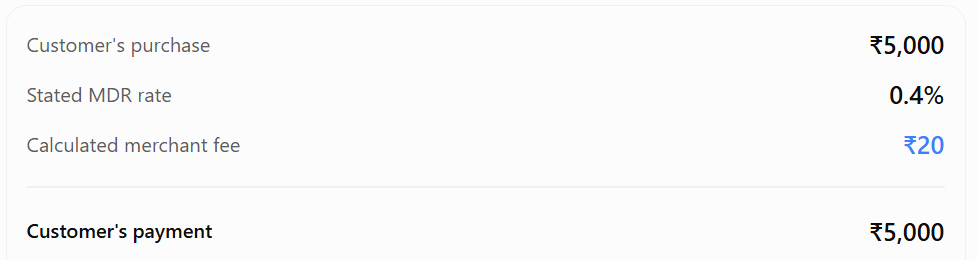
The key distinction is simple:
The announced MDR is a merchant-side processing charge, not an automatic additional fee that the consumer must pay on top of the purchase.
But that does not end the discussion. The way businesses respond to the cost is equally important.
3. What Remains Free for Consumers?
This is where many people may have misunderstood the announcement.
The provided information does not describe a universal charge on all UPI transactions.
Several categories are stated to remain free or exempt.
🤝 Person-to-Person Payments (P2P)
Sending money to friends and family remains free under the stated framework, regardless of the amount.
For example:

These are P2P transactions, not ordinary merchant purchases.
Whether you are splitting dinner, sending rent money to a family member, or transferring funds to a friend, the supplied framework states that these payments remain free.
Merchant Payments Up to ₹2,000
The provided details state that purchases up to ₹2,000 at businesses have zero MDR.
Imagine purchasing groceries worth ₹1,500.
You scan the store's QR code, complete the payment, and the stated MDR is ₹0.
The threshold matters: The provided information specifies payments up to and including ₹2,000 as zero MDR, while eligible payments above ₹2,000 fall under the relevant framework.
Small Vendors
According to the supplied details, vendors earning below ₹1 lakh per month are completely exempt.
This is intended to protect qualifying small businesses, including local shops and street vendors, from the stated MDR charges.
Eligibility, however, depends on the actual rules and classifications. A business should not assume that revenue alone establishes its eligibility without checking the applicable requirements.
Rural and Semi-Urban QR Payments
The supplied information also describes zero charges for merchant QR payments in rural and semi-urban zones.
This distinction is relevant because India's digital payment ecosystem extends far beyond major cities.
The precise applicability of the exemption depends on the relevant geographical and transaction criteria.
4. The New MDR Structure: How Much Will Merchants Pay?
The proposed framework describes different charges for different categories.
General merchants
0.4%
Eligible merchant transactions above ₹2,000.
Maximum cap
₹300
The supplied information specifies a cap for transactions of ₹75,000 or more.
Special sectors
₹5
Railways, telecom, insurance, and fuel.
Stated flat fee per eligible transaction above ₹2,000.
Mutual funds & securities
0.02%
Special percentage rate with a stated cap of ₹300.
General merchant examples
Let's calculate the fee using the stated 0.4% rate.

The last example assumes the stated ₹300 cap applies.
The mathematics is straightforward, but the business impact depends on how many eligible transactions a merchant processes.
A single ₹20 charge may seem small. But when a business processes thousands of qualifying transactions each month, the aggregate cost can become significant.

5. Why Do Railways, Telecom, Insurance, and Fuel Have a Flat ₹5 Fee?
The provided framework describes a flat fee of ₹5 per eligible transaction above ₹2,000 for certain sectors.
This is different from the general 0.4% percentage-based rate.
Example: A railway booking
Suppose you book a railway ticket for ₹3,500.
Under the stated flat-fee category:
Ticket value: ₹3,500
Stated fee: ₹5
Calculated merchant-side fee: ₹5
The fee does not increase proportionally with the ticket price under this flat-fee example.
Why does the distinction matter?
A flat fee and a percentage-based fee have different effects at different transaction values.
For example:

This comparison is purely mathematical. It does not establish which category a specific payment qualifies for or whether all transactions in those sectors are covered.
The important takeaway is that different industries can have different payment pricing structures.
6. Mutual Funds and Securities: Why Is the Rate Only 0.02%?
The supplied information describes a special rate of 0.02%, capped at ₹300, for mutual funds and securities.
Let's understand the numbers.
Example: ₹10,000 transaction
₹10,000×0.0002=₹2₹10,000 \times 0.0002 = ₹2₹10,000×0.0002=₹2
Calculated fee: ₹2.
Example: ₹1,00,000 transaction
₹1,00,000×0.0002=₹20₹1,00,000 \times 0.0002 = ₹20₹1,00,000×0.0002=₹20
Calculated fee: ₹20.
Example: ₹15,00,000 transaction
₹15,00,000×0.0002=₹300₹15,00,000 \times 0.0002 = ₹300₹15,00,000×0.0002=₹300
The stated cap is reached at ₹300.
The different rate demonstrates that the proposed MDR framework is not uniform across all eligible merchant categories.
The precise policy rationale and applicability should be assessed based on the relevant implementation details.
7. Why Does UPI Infrastructure Need Funding?
Here's a question that deserves more attention:
If consumers are not directly charged, who pays for the technology that makes UPI work?
A UPI payment may take just a few seconds, but the infrastructure behind it must support large volumes of transactions reliably.
It involves:
🔐 Security: Protecting payment systems and reducing fraud risks.
🖥️ Infrastructure: Supporting servers, connectivity, and operational reliability.
🏦 Banking systems: Enabling transactions through participating financial institutions.
📊 Monitoring: Tracking and managing transaction operations.
🛠️ Maintenance: Keeping systems available and functioning effectively.
The information supplied for this article references industry estimates of approximately ₹20,000 crore annually as the cost of running UPI infrastructure. This figure is an attributed estimate and should not be treated as independently verified financial data.
The larger economic question remains relevant:
How can India sustain a digital payment ecosystem that is accessible to consumers while ensuring that the underlying infrastructure is adequately supported?
Merchant-side charges are one possible component of a payment ecosystem's commercial model. The effect depends on the specific rates, exemptions, participants, and allocation arrangements.
8. The Biggest Concern: Will Consumers Eventually Pay More?
This is where the debate becomes complicated.
The supplied information states that merchants are not permitted to pass the applicable MDR directly to customers.
But consumers are asking:
"What if businesses try to recover the cost in other ways?"
Consider three possible scenarios.
Scenario 1: The merchant absorbs the cost
A business pays the applicable MDR and keeps its customer-facing price unchanged.
For example, a ₹5,000 purchase remains ₹5,000 for the customer.
Scenario 2: The merchant reviews overall pricing
A business evaluates its operating expenses, including payment processing costs, when making broader pricing decisions.
Any price change would need to be distinguished from an impermissible direct surcharge for using UPI.
Scenario 3: A merchant asks for an additional UPI fee
A business might attempt to charge a separate amount because the customer chooses UPI.
Whether that action complies with the applicable rules depends on the circumstances and the relevant enforcement framework.
These scenarios are possibilities for analysis, not predictions that all merchants will follow a particular pattern.
The distinction between a permitted business price and a prohibited payment-method surcharge is important.
9. Is This the "Enshittification" of UPI?
The word enshittification has become popular in online conversations about digital platforms.
It is generally used to describe a perceived pattern in which a platform attracts users through convenience or affordability and later changes its commercial model or experience in ways that users dislike.
Some people are comparing this idea to the UPI announcement.
Why?
Because millions of people have grown dependent on UPI for daily payments.
The concern is that when a platform becomes essential, users may have less flexibility if the commercial terms change.
But does a merchant-side fee automatically mean UPI is becoming worse?
Not necessarily.
To understand the real impact, we need to consider:
Does the customer face a direct surcharge?
Are small vendors protected?
Are the exemptions clearly implemented?
Is the fee structure transparent?
How are the costs allocated?
Does the payment experience remain reliable and accessible?
A fee change should be evaluated through its actual rules and outcomes—not through assumptions alone.
10. What Does a 0.4% Fee Mean for a Business?
Let's take an example of a merchant processing 1,000 eligible transactions in one month.
Each transaction is worth ₹5,000.
Total transaction value
1,000×₹5,000=₹50,00,0001,000 \times ₹5,000 = ₹50,00,0001,000×₹5,000=₹50,00,000
The business processes ₹50 lakh in eligible payments.
Total MDR
MDR per transaction:
₹5,000×0.004=₹20₹5,000 \times 0.004 = ₹20₹5,000×0.004=₹20
Monthly calculated MDR:
1,000×₹20=₹20,0001,000 \times ₹20 = ₹20,0001,000×₹20=₹20,000
Monthly payment volume
₹50 lakh
Number of eligible payments
1,000
Illustrative calculated MDR
₹20,000
Assumes all 1,000 payments qualify for the stated 0.4% rate, with no exemptions or other adjustments.
This example shows why transaction volume matters.
For a business processing large numbers of eligible payments, even a small percentage-based fee can become a meaningful operating expense.
The actual impact on profitability depends on the merchant's margins, other costs, exemptions, and payment arrangements.
11. The Bigger Picture: What Does This Mean for India's Digital Economy?
India's UPI story is not just about QR codes.
It represents a broader shift toward digital financial infrastructure.
UPI has supported convenient payments for consumers and businesses, but a large payment ecosystem also raises questions about:
🔐 Security and trust
Digital payment systems must maintain strong safeguards against fraud and unauthorized transactions.
🏪 Business sustainability
Merchants need payment services that fit their operational and financial realities.
📱 Accessibility
Digital payments should remain usable across different regions, income groups, and business environments.
💰 Funding and pricing
The payment ecosystem needs clear commercial arrangements that support infrastructure while considering the impact on participants.
⚖️ Consumer protection
Rules concerning additional charges, transparency, and complaint resolution matter when payment costs change.
The October 15 framework provides an opportunity to examine these issues together.
12. What Should UPI Users Do?
You don't need to assume that every UPI payment will become chargeable.
Instead, focus on understanding your payment category and checking unexpected fees.
✅ A simple checklist
Understand P2P vs P2M: Sending money to a friend is different from paying a business.
Check the amount: The stated framework distinguishes payments up to ₹2,000 from eligible payments above that threshold.
Understand exemptions: Small vendors and qualifying rural or semi-urban transactions may be covered by specific exemptions.
Review unexpected charges: Ask for clarity if a merchant adds a separate UPI surcharge.
Keep payment records: Save transaction confirmations when needed.
Use appropriate complaint channels: If you believe a payment rule has been violated, review the applicable official process.
Most importantly, don't confuse a merchant-side MDR with an automatic consumer fee.
🌟Is India's UPI Story Changing Forever?
UPI has transformed the way India pays.
From small tea stalls to major retailers, digital payments have become a part of everyday economic activity. The convenience of instant transactions has helped change consumer habits and business operations alike.
The proposed merchant MDR structure introduces a new discussion about how this massive payment ecosystem is funded.
Under the information provided:
✅ P2P transfers remain free.
✅ Merchant payments up to ₹2,000 remain at zero MDR.
✅ Certain small vendors and rural or semi-urban transactions are described as exempt.
✅ Eligible general merchants face a stated 0.4% MDR above ₹2,000.
✅ Specific sectors have flat-fee or special-rate structures.
The real story will depend on the details of implementation, the protection of consumers and eligible merchants, and the way the payment ecosystem evolves.
UPI's future should be understood not just through the cost of making a payment, but through the broader question of how India can maintain a secure, accessible, and sustainable digital payment system.
#UPI #UPI2026 #DigitalIndia #DigitalPayments #FinTech #MDR #MerchantPayments #IndianEconomy #PaymentTechnology #CashlessIndia #NPCI #FinancialAwareness #DigitalTransformation #IndianBusiness #FutureOfPayments #TechnologyInIndia #UPICharges #FinancialTechnology #IndiaDigitalRevolution #BusinessInIndia


Comments