
🌊 Why Is India Facing Floods Everywhere? Causes, Impact & Solutions

India is facing floods in almost every part of the country. From the mountains of Himachal Pradesh and Uttarakhand to the floodplains of Assam, and from major cities like Mumbai, Pune, Bengaluru and Noida, flooding is becoming an increasingly serious problem.
But why are floods happening in places with completely different geography?
The answer is a combination of climate change, extreme rainfall, rapid urbanisation, deforestation, encroachment of wetlands and floodplains, poor drainage systems, river pollution and unplanned development.
While heavy rainfall is a natural phenomenon, the increasing damage caused by floods is also linked to how India is managing its land, rivers and cities.
Why Are Floods Becoming More Frequent in India?
India's monsoon has always brought heavy rainfall, but rainfall patterns are becoming increasingly unpredictable.
Instead of rain being spread relatively evenly over several days, many areas are experiencing short-duration, high-intensity rainfall. A large amount of water can fall within a few hours, overwhelming drainage systems, rivers and natural water-storage areas.
Climate change is an important factor because a warmer atmosphere can hold more moisture, potentially contributing to more intense rainfall events.
This creates a dangerous combination:
Extreme rainfall + poor drainage + unplanned development = severe flooding.

Why Are Himachal Pradesh and Uttarakhand Facing Flash Floods?
The Himalayan states face a unique flood risk.
Himachal Pradesh and Uttarakhand have steep slopes, narrow valleys, fragile geological formations and fast-flowing rivers. During extreme rainfall, water moves rapidly down mountain slopes, sometimes triggering flash floods and landslides.
Human activity can make these risks worse.
Unscientific hill cutting, deforestation, road construction, quarrying and construction in sensitive areas can disturb natural slopes and drainage patterns.
This does not mean development should stop. Roads, tourism and infrastructure are essential for the Himalayan economy.
However, development must consider the carrying capacity and geological sensitivity of the mountains.
Why Does Assam Flood Every Year?
Assam's flood problem is closely connected to the Brahmaputra River and its tributaries.
During the monsoon, heavy rainfall across the river basin sends enormous quantities of water downstream.
The situation becomes more complicated because of:
Heavy upstream rainfall
Siltation
Riverbank erosion
Changing river channels
Floodplain settlements
Pressure on embankments
The Brahmaputra carries a huge amount of sediment, and changes in river channels and sediment deposition can affect how water moves through the basin.
For people living in Assam's flood-prone areas, floods can destroy crops, homes, roads and livelihoods almost every year.
Why Are Mumbai, Pune, Bengaluru and Noida Flooding?
Urban flooding has a different story.
Cities naturally have soil, vegetation, lakes, wetlands and open spaces that absorb rainwater.
But rapid urbanisation has replaced many of these natural surfaces with concrete.
🏢 Buildings🛣️ Roads🅿️ Parking areas🏗️ Construction
Concrete prevents rainwater from entering the ground.
Instead, huge quantities of water run across roads and enter stormwater drains.
When rainfall becomes more intense than the drainage system can handle, the city floods.
This is why even cities without major rivers can experience serious flooding.
Wetlands and Lakes Are India's Natural Flood Protection
One of the biggest mistakes in urban planning is treating wetlands, lakes and floodplains as empty land.
They are actually natural flood-management systems.
Wetlands can temporarily store excess rainwater, while lakes and open areas can slow down runoff.
When these areas are filled, encroached upon or converted into buildings, cities lose their natural ability to absorb water.
Therefore, protecting wetlands is not simply an environmental issue.
It is a flood-prevention strategy.
Choked Drains Make Urban Flooding Worse
Another major problem is inadequate stormwater drainage.
During the monsoon, drains can become blocked by:
🗑️ Plastic🧱 Construction debris🍾 Bottles🌿 Leaves and silt🚮 Household waste
When heavy rain arrives, blocked drains cannot carry water away quickly.
Many drainage networks were also designed decades ago when cities had much smaller populations and significantly less concrete coverage.
Today, rapidly expanding cities need drainage systems capable of handling modern rainfall intensity and future climate risks.
Government Must Focus on River Cleaning and Restoration
Flood management should not stop at building drains and embankments.
Healthy rivers are an important part of India's water-management system.
The government has already undertaken major river-cleaning and rejuvenation efforts, including Namami Gange, which focuses on reducing pollution in the Ganga through sewage treatment, industrial pollution control and other interventions.
But river cleaning should mean more than simply removing visible garbage.
A healthy river requires a healthy ecosystem around it.
Government efforts should therefore focus on:
💧 Treating sewage before it enters rivers
🏭 Controlling industrial pollution
🌳 Protecting river catchments and forests
🏞️ Restoring wetlands
🌊 Protecting floodplains
🗑️ Preventing solid waste from reaching waterways
🌱 Restoring natural drainage channels
The focus should gradually shift from "cleaning polluted rivers" to "preventing rivers from becoming polluted in the first place."
River management should also be planned at the entire river-basin level, because water does not follow state or district boundaries.
What Should the Government Do to Reduce Floods?
India needs a long-term flood-management strategy.
1. 🌧️ Upgrade Drainage Systems
Cities should redesign and expand stormwater networks based on current rainfall patterns and future climate projections.
2. 🏞️ Protect Wetlands and Floodplains
Natural water-storage areas should be mapped and protected from illegal encroachment.
3. 🌳 Protect Forests
Especially in Himalayan regions, forests help stabilise slopes, reduce erosion and slow water runoff.
4. 🏗️ Regulate Construction
Construction in floodplains, riverbanks and landslide-prone mountain areas needs stronger scientific assessment.
5. 📡 Improve Early-Warning Systems
Weather radar, satellite monitoring, river gauges and emergency mobile alerts can provide valuable time for evacuation.
6. 🌊 Restore Rivers and Natural Waterways
River cleaning should go together with sewage treatment, pollution control, wetland restoration and protection of natural drainage channels.
7. 🗺️ Create Flood-Risk Maps
Cities should identify high-risk areas, evacuation routes, emergency shelters and critical infrastructure before disasters happen.
👨👩👧 What Can Citizens Do?
Flood prevention is not only the government's responsibility.
Citizens also have an important role.
🗑️ Don't throw plastic or garbage into drains, rivers and lakes.
🌳 Protect trees and local green spaces.
💧 Use rainwater harvesting where possible.
🏠 Avoid construction that blocks natural drainage pathways.
📱 Take government weather and evacuation warnings seriously.
🚗 Never underestimate moving floodwater while driving or walking.
A plastic bag thrown onto a street may seem harmless, but thousands of such pieces can eventually block drainage systems during heavy rainfall.
🇮🇳 India Needs to Stop Fighting Water and Start Managing It
India cannot stop the monsoon.
It cannot prevent every extreme rainfall event.
But it can significantly reduce the damage.
The country needs a combination of:
Climate-resilient infrastructure + clean rivers + protected wetlands + scientific urban planning + responsible construction + better drainage + early warnings + public awareness.
The biggest lesson is simple:
Floods may be natural, but the scale of the disaster is often influenced by human decisions.
If wetlands are destroyed, floodplains are occupied, forests are removed, drains are blocked and rivers are polluted, extreme rainfall becomes far more dangerous.
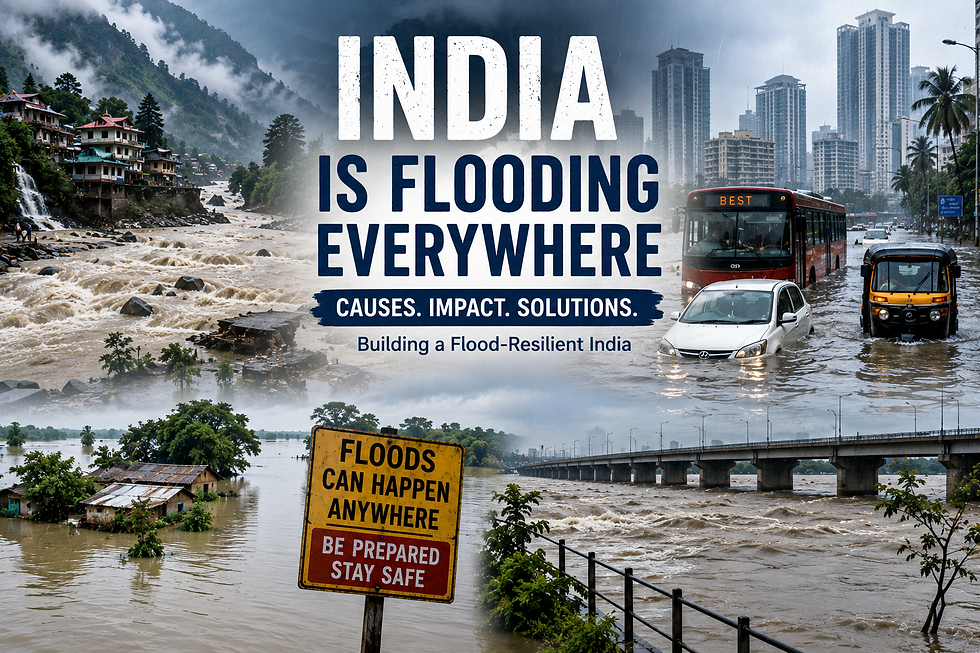
From Himachal Pradesh and Uttarakhand to Assam, Mumbai, Pune, Bengaluru and Noida, India's flood crisis has different local causes but a common underlying problem: we are not always giving water enough safe space to flow, spread and be absorbed.
Climate change is increasing the challenge, but better planning can reduce vulnerability.
The government must focus on modern drainage, river cleaning and restoration, wetland protection, scientific construction, flood forecasting and climate-resilient infrastructure.
Citizens must contribute by keeping waterways clean, protecting natural ecosystems and following disaster warnings.
🌊 We cannot stop the rain. But we can decide how prepared India is when the rain arrives.
That is the real challenge—and the real opportunity—for India.
#IndiaFloods #FloodsInIndia #ClimateChange #UrbanFlooding #FloodManagement #RiverCleaning #NamamiGange #RiverRestoration #AssamFloods #MumbaiFloods #PuneFloods #BengaluruFloods #NoidaFloods #HimachalPradesh #Uttarakhand #Brahmaputra #Wetlands #UrbanPlanning #ClimateResilience #DisasterManagement #WaterManagement #FloodPrevention #SustainableIndia #Monsoon #EnvironmentalProtection


Comments