
🌎🤝 India & Brazil Aim High: $20 Billion Trade Target, Rare Earth & Digital Deals Signal New Global Power Shift 🇮🇳🇧🇷📈

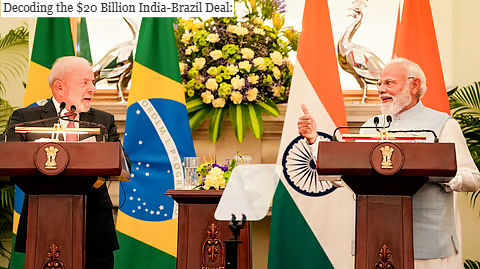
In a landmark diplomatic development, Prime Minister Narendra Modi and President Luiz Inácio Lula da Silva have charted an ambitious new course for India-Brazil relations.
From setting a bold $20 billion bilateral trade target to signing critical agreements in rare earth minerals and digital technology, this partnership is not just about economics — it’s about reshaping global supply chains, strengthening the Global South, and building strategic autonomy in a rapidly changing world.
🎯 A Bold Economic Vision: $20 Billion in Trade
India and Brazil have set a target to increase bilateral trade to $20 billion within the next five years 📊.
Currently, trade between the two nations stands strong, but both leaders believe the true potential is far greater. This new target reflects:
📦 Expanded export-import cooperation
🚢 Improved logistics and trade facilitation
🏭 Stronger industrial partnerships
🌾 Agricultural collaboration
💊 Pharmaceutical and healthcare expansion
This isn’t just a symbolic number. A $20 billion trade relationship would:
✔️ Create thousands of new jobs
✔️ Strengthen MSMEs in both countries
✔️ Boost manufacturing
✔️ Reduce dependency on limited trade partners
✔️ Enhance long-term economic resilience
And interestingly, there are signals that this number could grow even further in the coming decade.
🪨 Rare Earth & Critical Minerals: A Strategic Masterstroke ⛏️
One of the most significant outcomes of the meeting was cooperation in rare earth elements and critical minerals.
Why Rare Earths Matter 🔋
Rare earth minerals are essential for:
🚗 Electric Vehicles (EV batteries & motors)
📱 Smartphones & electronics
☀️ Solar panels & renewable energy
🛰️ Aerospace & defense systems
💻 Advanced computing & semiconductors
Brazil possesses substantial reserves of rare earth minerals, while India is rapidly expanding its clean energy and high-tech manufacturing sectors.
This partnership allows:
🔹 Diversification of supply chains
🔹 Reduced over-dependence on dominant global suppliers
🔹 Joint exploration & processing
🔹 Long-term mineral security
In today’s geopolitics, critical minerals are the “new oil.” Whoever controls access controls the future of clean energy and advanced tech.
This agreement is strategic, forward-thinking, and highly significant.
💻 Digital Partnership: Powering the Future Together
Beyond minerals, the two leaders signed agreements focused on digital transformation and technology cooperation.
India’s digital revolution over the past decade has been remarkable. From digital public infrastructure to fintech innovation, India has positioned itself as a global digital leader.
Now, Brazil and India are collaborating on:
🌐 Digital Public Infrastructure
🤖 Artificial Intelligence (AI)
🔐 Cybersecurity
🧠 Innovation ecosystems
💳 Financial technology systems
🧩 Blockchain applications
There are discussions around establishing digital cooperation frameworks that could help Brazil benefit from India’s experience in large-scale digital governance systems.
This isn’t just tech sharing — it’s digital empowerment.
🏗️ Mining & Industrial Cooperation
Apart from rare earths, broader mining and industrial agreements were also discussed.
India’s infrastructure expansion requires:
Steel
Industrial minerals
Energy resources
Brazil, being resource-rich, becomes a natural strategic partner.
This means:
✔️ Strengthened steel and infrastructure supply chains
✔️ New investments in mineral exploration
✔️ Increased bilateral industrial cooperation
It creates a mutually beneficial growth ecosystem.
🌍 The Bigger Picture: Global South Leadership
This partnership goes beyond trade.
India and Brazil are two major democracies representing the Global South. Both nations advocate for:
🌎 Reform in global governance
🏛️ Stronger representation in international institutions
📈 Fairer trade frameworks
🤝 Multipolar global cooperation
Their collaboration sends a clear message: Emerging economies are shaping the next chapter of global power dynamics.
This is about strategic autonomy — not dependency.
📊 Why This Deal Is So Important
Let’s understand the broader impact:
1️⃣ Supply Chain Security
In a world disrupted by geopolitical tensions and trade bottlenecks, diversification is critical.
2️⃣ Clean Energy Acceleration
Critical minerals enable renewable energy expansion.
3️⃣ Technological Sovereignty
Digital cooperation strengthens independence in AI, fintech, and semiconductors.
4️⃣ Economic Growth
Higher trade volumes mean stronger GDP contributions for both nations.
5️⃣ Long-Term Strategic Alignment
India and Brazil are building a relationship that extends beyond short-term gains.

🚀 Looking Ahead
While $20 billion is the immediate target, the long-term potential could be even greater.
Future areas of expansion may include:
🌱 Green hydrogen collaboration
🛡️ Defense partnerships
🏥 Healthcare & pharma exports
🎓 Education & research exchanges
💰 Local currency trade mechanisms
This meeting may well become a defining moment in India-Brazil relations.
🔮Powering the Future
The meeting between Narendra Modi and Luiz Inácio Lula da Silva marks a decisive step toward a stronger, more strategic Indo-Brazil partnership.
From rare earth minerals to digital ecosystems, from trade expansion to geopolitical alignment — this collaboration reflects confidence, ambition, and a shared vision for the future.
Two continents.Two democracies. One powerful strategic direction.
The world is watching — and this partnership could redefine how emerging economies collaborate in the 21st century.


Comments